
 Shahneel Ijaz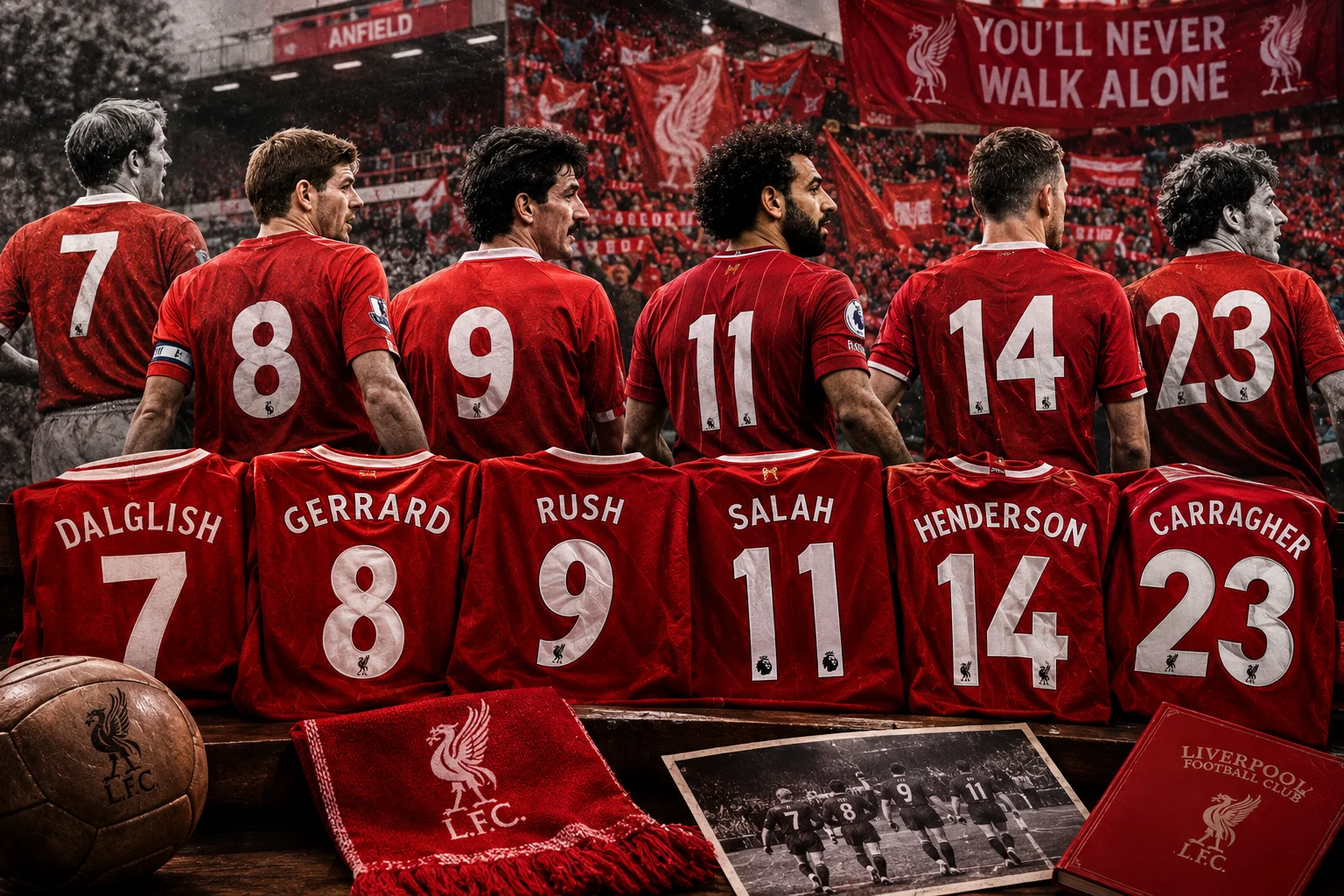
A number on the back of a Liverpool shirt is never just a number. It is a lineage. Wear 7 and you are measured against Dalglish; wear 9 and you are measured against Rush; wear 8 and you are measured against a captain who scored in every final he played in. Supporters know the lineage, players know it, and the club knows it well enough that the number is often part of the negotiation when a signing is made. This is a guide to the numbers on a Liverpool kit, the men who defined them and the men who carry them in 2026/27.
When numbers meant positions
Until 1993 there were no squad numbers. Players wore 1 to 11 position, so the number 7 was the outside right, the 9 was the centre-forward and the 4 was a wing-half. The Premier League introduced fixed squad numbers for the 1993/94 season, and from that moment a number became something a player owned. Liverpool’s great shirts of the pre-1993 era, Keegan’s 7, Hughes’s 6, Souness’s 11, were worn because of where the man played, not who he was. That changed quickly.
Number 7: Keegan, Dalglish and the weight of it
The 7 is Liverpool’s heaviest shirt. Kevin Keegan wore it through the first European Cup in 1977, and when he left for Hamburg Kenny Dalglish arrived from Celtic and took it over, scoring the winner at Wembley in 1978 and going on to become the club’s greatest player. Peter Beardsley had it in the late 1980s. In the squad-number era it has been worn Luis Suárez at his most brilliant and most difficult, then James Milner for eight steady seasons. Whoever wears it next inherits the comparison whether they want it or not.
Number 8: Gerrard
Steven Gerrard wore 28 and then 17 before settling on 8 in 2004, and he made the number his in a way no Liverpool player has managed with any other. The 2005 Champions League final, the 2006 FA Cup final and his 186 goals for the club all came in it. After his departure the 8 passed to Na Keïta and then, from 2023, to Dominik Szoboszlai, who has worn it through the 2025 title and into the current season. It is, common consent, the hardest number in the squad to justify.
Number 9: Rush, Fowler, Torres, Firmino
Ian Rush wore the 9 as the centre-forward of the 1980s and scored 346 goals, still the club record. Robbie Fowler took it in the mid-1990s, Fernando Torres made it his in 2007 with a season of 33 goals, and Roberto Firmino wore it as the false nine of Klopp’s best side. Darwin Núñez had it from 2022 until his sale in 2025, when Alexander Isak arrived from Newcastle and inherited the shirt. The 9 at Liverpool is unusual in that its holders have played very different roles, from poacher to link-man, and the number has survived every reinvention.
Number 10: Barnes to Mac Allister
John Barnes wore 10 in the 1989 to 1991 team, the side whose shirt is the inspiration for this season’s kit. Michael Owen wore it in the treble season of 2001, Philippe Coutinho made it the creative heart of Klopp’s early years and Sadio Mané took it after Coutinho left. Alexis Mac Allister has worn 10 since 2023 and reached the 2026 World Cup final with Argentina in it.
Number 11: Salah
Mohamed Salah took the 11 on his arrival in 2017 and has made it the best-selling shirt in the club’s modern history, with two Premier League titles, a Champions League and more goals than any Liverpool player of the squad-number era. If any number is retired at Anfield in the coming decade, it will be this one, or the one below.
Number 20: Diogo Jota
The 20 belonged to Diogo Jota from 2020 until his death in a car accident in July 2025, weeks after the title had been won. The club retired the number across all its teams in his memory, a decision announced within days and supported without a dissenting voice. It is the first number Liverpool have withdrawn, and it will not be worn again.
The defenders’ numbers
Number 4 has passed from Sami Hyypiä to Virgil van Dijk, captain of the 2025 champions. Number 23 was Jamie Carragher’s for most of his 737 games. Number 26 has been Andy Robertson’s since 2017, the Scotland captain having worn it through every trophy of the Klopp era. Number 66, Trent Alexander-Arnold’s, has been vacant since his move to Real Madrid in 2025, and the club has been in no hurry to reassign it.
Number 1 and the goalkeepers
Ray Clemence wore the 1 for the European Cups of 1977, 1978 and 1981, and Bruce Grobbelaar for the fourth in 1984. In the squad-number era the shirt has been more complicated. Pepe Reina, the club’s best keeper of the 2000s, chose 25 and kept it for eight seasons, so the 1 was worn a series of back-ups until Alisson Becker arrived in 2018 and took it back. His header at West Brom in 2021 and his part in the 2019 and 2025 triumphs have restored the number to its old standing.
Number 17 and the ones that moved
Steve McManaman wore 17 through the 1990s, Gerrard wore it before the 8, and Curtis Jones has worn it since 2020, the longest-serving academy graduate in the current squad. It is a number that seems to belong to players who came through Melwood and Kirk rather than to signings. The 14 was Jordan Henderson’s for twelve years, including the captaincy of the 2019 and 2020 sides, and has been passed on carefully since he left. At Liverpool, more than at most clubs, a number’s previous owner is part of what a player is buying into.
The numbers in 2026/27
The numbers themselves look different this season. Liverpool introduced a new typeface for names and numbers, drawn from the wings and talons of the Liver bird, and it appears on the back of the 2026/27 adidas home shirt alongside the geometric graphic revived from the 1989 to 1991 kit. Florian Wirtz wears 7, an inheritance that would have seemed unthinkable for a new signing a generation ago, and Hugo Ekitike wears 22.
Every away end tells the same story. Look along the row and you will see 7s, 8s, 9s, 10s and 11s from every era, Dalglish beside Suárez, Gerrard beside Szoboszlai, and the occasional 20 that nobody will ask about. The numbers are the club’s history worn on the back. For more on Liverpool’s players, kits and the trips to see them, explore LFC Day Trippers.