
 henrybella2211@gmail.com
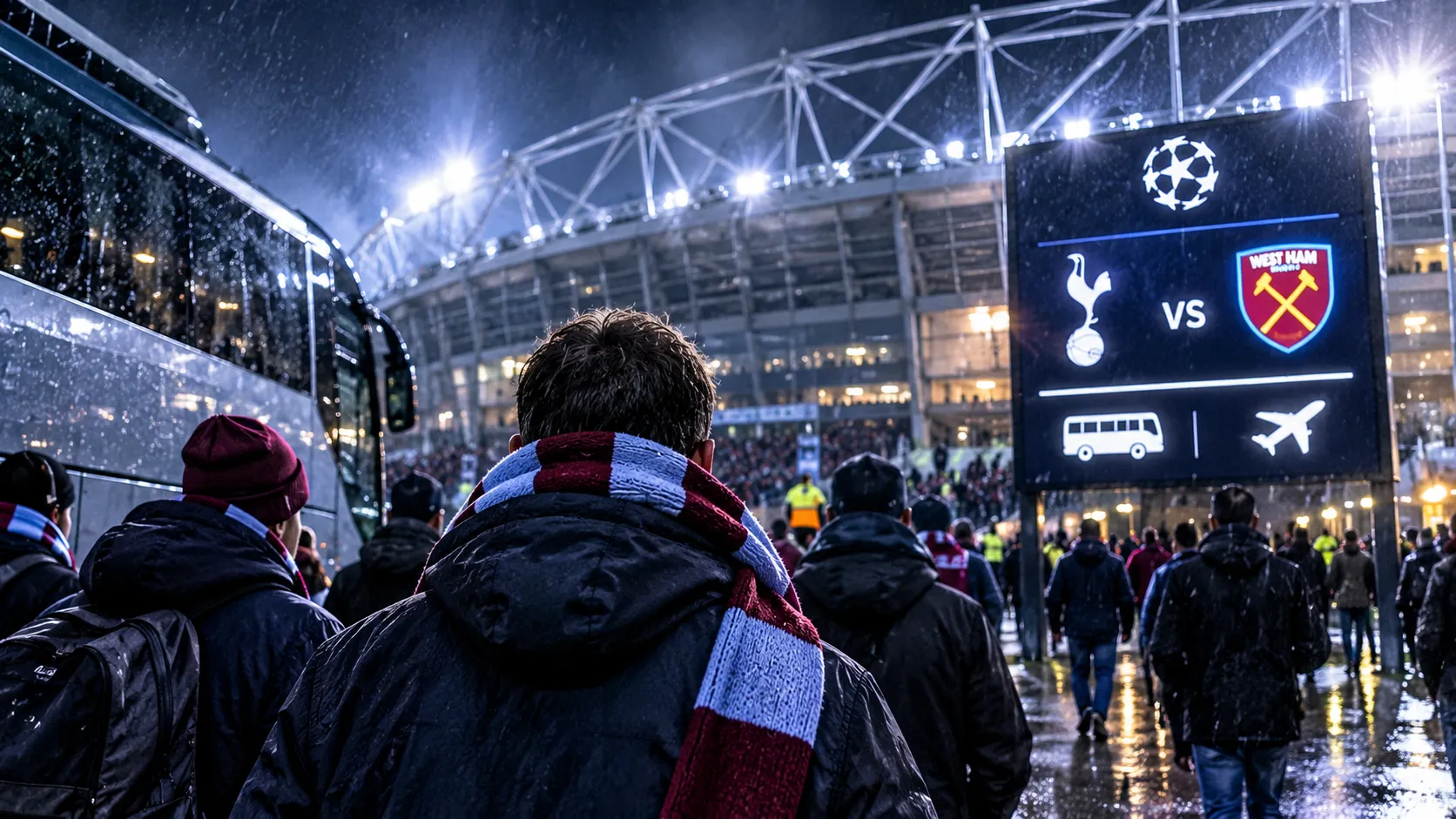
Anyone will do a Saturday away day in April. A Tuesday night three hundred miles up the line in February, with work at eight the next morning and a last connection that leaves before the final whistle, is a different proposition and it is the one that separates the people who follow a club from the people who watch it.
Which is exactly why midweek away games are the real test, and also why they produce the best away ends in football. Everyone who is there has paid a genuine price to be there, and it shows.
The logistics are the whole problem
A Saturday three o’clock kick-off gives you a full day in either direction. A Tuesday seven forty-five finishes at about half nine, which leaves you needing to cross the country at an hour when the railway has largely stopped trying.
Work the return leg before you book anything. Find the last realistic connection home, add fifteen minutes for walking and a delay, and see whether it lets you watch the full match. If it does not, you have three options: an overnight stay booked in advance at a sensible price, a supporters’ coach scheduled around the fixture, or a car with three other people in it splitting the fuel.
The option that catches people out is assuming it will work out. It frequently does not, and a taxi to a mainline station at ten at night is the most expensive mistake in away travel. Our guide to planning an away day train covers the booking side.
Why is the atmosphere usually better?
Self-selection. A midweek allocation is bought the people who were always going to go, which means the away end is almost entirely made up of regulars who know the songs and will sing them without prompting.
The home end is frequently the opposite. Midweek crowds are smaller, the casual support stays at home, and large parts of the ground can be noticeably quiet which makes a travelling section of two thousand sound considerably larger than it is. There are grounds where an away end is comfortably the loudest thing in the stadium on a Tuesday and barely audible on a Saturday.
The floodlights help too, and that is not purely romantic. A night match under lights looks and feels different: the pitch is brighter than its surroundings, the crowd is darker and less visible, and the whole thing is more concentrated. Players talk about it as well as supporters.
Where do the loyalty points come in?
If your club operates a points system and most do midweek games are where the value sits. They are the fixtures with the lowest demand and the same points value as anything else, which makes them the cheapest route to the allocation you actually want later in the season.
That produces a pattern among experienced away supporters: do the unglamorous ones, bank the points, and you are in the ballot for the fixture everybody wants. A supporter who has done four midweek trips in autumn is in a far stronger position in March than one who applied for the glamour tie first.
Cup ties are the sharpest version of this. A midweek third-round tie at a lower-league ground is cheap, easy to get and worth the same points as anything else, and it is often a better day out than the league fixture it displaced.
What to actually take
Less than you think, and warmer than you think. A night game in the away end at a northern ground in January is genuinely cold, and you will be sitting still for two hours after standing outside for one. Layers under the shirt, a thin waterproof rather than a heavy coat, and gloves you will not mind losing.
Food for the journey home, because nothing will be open. A charged phone and a screenshot of your ticket, since away-end signal is unreliable and a flat battery at a turnstile is a specific kind of misery. And a card, because grounds are cashless and the machines near charge.
What to leave: anything you would mind carrying for twelve hours. Eating properly beforehand matters more midweek than at any other time, which is covered in the best food near football grounds.
The fixtures worth doing midweek
Not all of them, and being selective is sensible rather than disloyal. The ones that reward the effort share a few features: a ground with a reputation for noise, a short enough journey that the return leg works, or a fixture with something actually at stake.
Cup ties at lower-league grounds are the best value in the category. They are cheap, the allocation is easy to get, the ground is usually a proper old one with the away end close to the pitch, and the home crowd turns up in numbers it never manages in the league. A third-round tie on a Tuesday is frequently a better night out than the Premier League fixture the same week.
The ones to think twice about are long journeys to large, quiet stadiums with nothing at stake. That is four hundred miles for a flat atmosphere and a sleepless night, and there is no shame in watching it at home.
The next-day problem
Nobody talks honestly about this part. A midweek away trip means four or five hours’ sleep and a working day on the other side of it, and the people who do this regularly have simply decided it is worth it.
The practical mitigations are modest: book the morning off if you can, do not drive the last leg if you have been drinking or are exhausted, and accept that the day after is a write-off rather than pretending otherwise. Several away regulars deliberately take the Wednesday as leave and treat the fixture as a short holiday, which is more sensible than it sounds.
It is also why midweek crowds skew towards people with flexible work and away from people with young children, and why the away end on a Tuesday looks different from the same end on a Saturday. That is worth remembering before judging anyone’s commitment their attendance record.
Why they are worth it anyway
Because the games you remember are disproportionately these ones. A routine win on a Saturday blends into the season; a Tuesday night in the rain at the other end of the country does not, regardless of the result.
There is also something about being one of a few hundred rather than one of fifty thousand. The away end on a midweek night is a small enough group that it behaves like one, and that is an experience the home fixtures cannot replicate at any price. If you are picking which trips to prioritise, the London Stadium away day is one of the easier midweek options, and groundhopping for beginners covers building a season around them.
Frequently asked questions
Are midweek away games cheaper?
The ticket is usually the same, and in the Premier League it is capped either way. Travel is often cheaper because demand is lower, but the return leg is the constraint rather than the price.
Why is the atmosphere better at night games?
Smaller, more committed crowds on both sides, plus the visual effect of floodlights concentrating attention on the pitch. Away ends in particular sound louder relative to a quieter home crowd.
Do midweek games earn the same loyalty points?
Usually yes, which is what makes them good value. They are the lowest-demand fixtures with the same points value, so they are the cheapest way to build towards a popular allocation.
What is the single most important thing to plan?
The journey home. Find the last realistic connection before booking anything else, because that decides whether the trip works at all.