 Shahneel Ijaz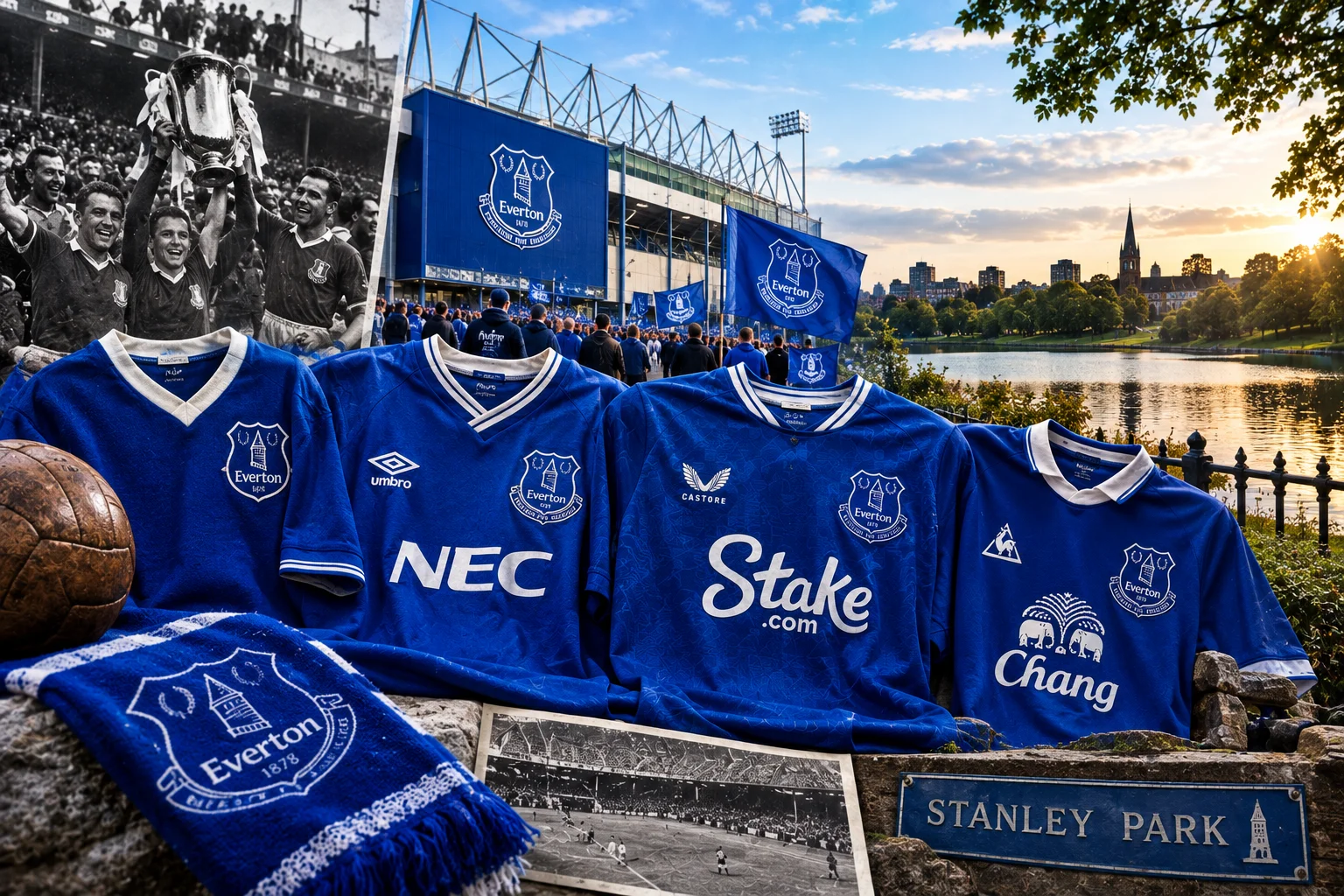
Every Liverpool supporter has an opinion on the Everton shirt, and most of them are unprintable. That is as it should be. But the royal blue on the other side of Stanley Park has a history that is bound up with our own more tightly than either side likes to admit, starting with the awkward fact that Everton played at Anfield first, and that Liverpool’s first kit was blue. This is the story of the other shirt in the city, told from this side of the park, and of what the move to the docks means for a rivalry that used to be measured in yards.
Everton at Anfield
Everton were formed in 1878, played at Anfield from 1884 and won their first league title there in 1891. The colours in those years were all over the place: black with a scarlet sash, then ru , then salmon. The split came in 1892, when a rent dispute with the landlord, John Houlding, led the Everton committee to leave Anfield and build Goodison Park on the far side of the park. Houlding, left with a ground and no team, founded Liverpool. His new club’s first shirts were blue and white halves. Red arrived in 1896, and Everton settled on royal blue in 1901. From then on the two sides of Stanley Park had their colours, and the der had its picture.
The shirts of the der years
For a century the two clubs were close enough to walk between, and the shirts faced each other in some of the biggest matches in English football. Everton’s plain blue of the 1960s was worn against Shankly’s all-red; the Le Coq Sportif shirt of 1984/85, with the Hafnia logo, was worn in the first Merseyside Wembley final, the 1984 League Cup, which Liverpool won after a replay. The NEC-sponsored Umbro shirt of 1986 and 1989 was worn in two all-Merseyside FA Cup finals, both won Liverpool, the second in 1989 a month after Hillsborough, when the city was briefly one colour.
Dixie Dean and Billy Liddell, Alan Ball and Tommy Smith, Neville Southall and Bruce Grobbelaar, Duncan Ferguson and anyone who would stand still: the der produced pairings that defined both shirts. Everton’s win at Anfield in February 2021 was their first there since 1999, a statistic Liverpool supporters had kept close for twenty-two years, but the 1980s belonged to them as much as to us, and the shirts of that decade sell on both sides of the park.
Sponsors, manufacturers and the blue that never changed
Everton’s front of shirt is a short history of Merseyside commerce: Hafnia, NEC, Danka, One2One, Kejian, and then Chang for thirteen years, long enough that a generation of Blues cannot picture the shirt without it. The manufacturers rotated, Umbro, Puma, Le Coq Sportif, Nike, Umbro again, Hummel and now Castore, and the trim moved between white, yellow and black. The body stayed royal blue. It is the one thing about Everton that Liverpool supporters would defend: whatever else happens, they have never messed with the colour.
Goodison, the last der and the move
Goodison Park hosted its last Merseyside der in February 2025, a 2-2 draw that ended with a mass confrontation and four red cards, which felt like the right way for that ground to sign off. Everton’s men’s team played their final match there in May and moved to the Hill Dickinson Stadium at Bramley-Moore Dock, a 52,769-seat ground on the northern waterfront. Goodison survives as the home of Everton Women. The der is now a two-mile trip rather than a walk across the park, which for the day-tripping supporter means a bus or a train instead of a stroll, and a very different backdrop.
The shirt for the new ground
Everton’s kit for the first season at the new stadium was designed around it. Castore’s 2025/26 home shirt carried a wave pattern through the royal blue, a reference to the Mersey that frames the new ground, with a modern V-neck and white trim, and it was worn for a 2-0 win over Brighton in the stadium’s first competitive match and for a mid-table season under David Moyes that Evertonians regarded as a relief. The 2026/27 home shirt keeps the royal blue and white; the away kit, in blue and yellow stripes, has been better received than most of their recent change kits. The adult replica is £80, five pounds less than Liverpool’s.
Prince Rupert’s Tower and the crest that was booed
Everton’s crest carries a small stone building called Prince Rupert’s Tower, a lock-up on Everton Brow that dates from 1787 and still stands, with two laurel wreaths and the Latin motto Nil Satis Nisi Optimum, nothing but the best is good enough. It has been on the shirt in one form or another since 1938. In 2013 the club unveiled a simplified crest without the wreaths or the motto, and the reaction was so hostile, more than 20,000 signatures on a petition within days, that the club apologised, put three alternatives to a supporters’ vote and restored a version with all the original elements for 2014. It remains the clearest example in English football of a kit decision being reversed the people who buy it.
The 1980s, when the blue was the better shirt
Between 1984 and 1987 the royal blue was worn the best team in the country. Howard Kendall’s side won the FA Cup in 1984, the league and the Cup Winners’ Cup in 1985 and the league again in 1987, and the ban on English clubs in Europe after Heysel is the reason that side never got to test itself in the European Cup. The Le Coq Sportif shirt with the Hafnia logo and the Umbro shirt with NEC are the designs Evertonians wear to the der to this day, and Liverpool supporters of that generation understand exactly why.
The rivalry from the away end
For Liverpool supporters who make the trip, the new ground changes the experience more than the football does. The walk from Anfield to Goodison, through the park past the two churches, was part of the der for 130 years. The waterfront stadium is reached from the city centre instead, and the away end looks out towards the river rather than the terraced streets. The shirts, at least, are the same: red at one end, royal blue at the other, and no confusion about which is which.
There is a grudging truth at the end of this. Everton’s shirt is one of the few in the country that has never needed a redesign to be recognisable, and the fact that it has been worn through relegation battles and points deductions without changing has earned it a respect that the club’s results have not. We would not wear it. We would not want it to be anything else. For more on the Merseyside der , the grounds and the trips between them, explore LFC Day Trippers.
[…] supporter covers delivery timing and returns. For how another club’s colour became its identity, Everton shirts and the royal blue of Stanley Park is worth […]