 Shahneel Ijaz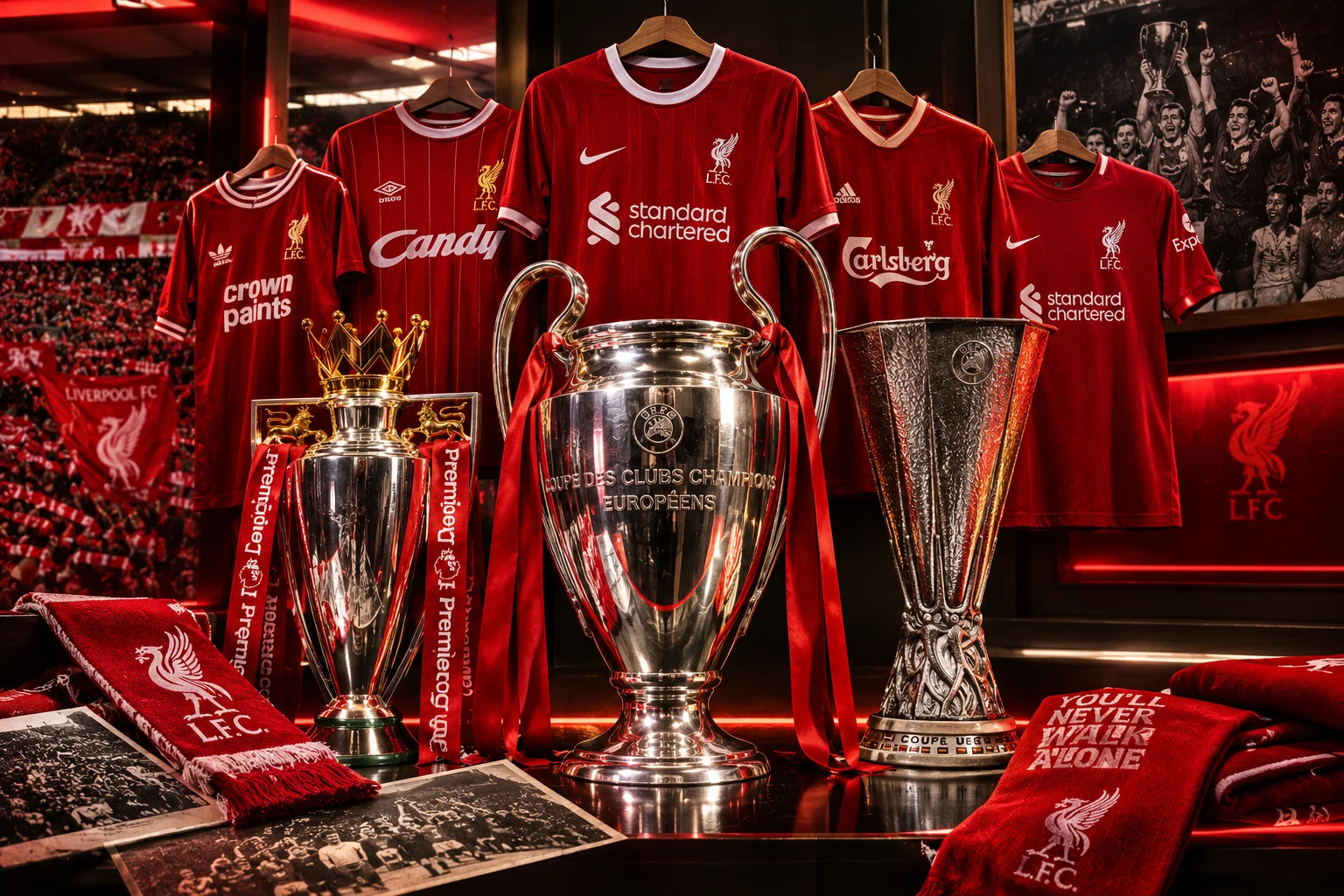
Ask a Liverpool supporter about a trophy and, more often than not, they will describe a shirt. The plain red of Rome. The Reebok with the Carlsberg logo that Steven Gerrard pulled over his head in Istanbul. The New Balance worn in Madrid. Each of the club’s biggest nights has a kit attached to it, and the memory of the match and the memory of the design are hard to separate. This is a tour through the Liverpool shirt the trophies it was worn for, ending with a 2026/27 design that reaches back to the last title of the old First Division era.
Before the red: 1892 to 1964
It is easy to forget that Liverpool did not start in all red. The club’s first kit, in 1892, was blue and white halves, the colours Everton had left behind when they crossed Stanley Park. Red shirts arrived in 1896, but they were worn with white shorts for the next seventy years, through the titles of the 1900s and 1920s and the FA Cup final of 1950. The all-red kit that the world now knows was Bill Shankly’s idea. He had the team wear red shorts against Anderlecht in the European Cup in November 1964, decided the effect was intimidating, and never went back. The first FA Cup, in 1965, was won in the new all-red.
Rome, London, Paris and Rome again: 1977 to 1984
The four European Cups of Bob Paisley and Joe Fagan were won in shirts so plain that they now look like retro reproductions of themselves. Umbro made the 1977 kit worn in Rome against Borussia Mönchengladbach, and Hitachi became the first sponsor on an English top-flight shirt in 1979, although the logo could not be worn in European competition or on television at first. Crown Paints took over in 1982 and was on the front for the 1984 final in Rome against Roma, decided on penalties after Bruce Grobbelaar’s wobbling legs. The kits of that era, red with a pinstripe here or a V-neck there, are the ones supporters mean when they talk about “the classic Liverpool shirt”.
1989 to 1991: the geometric adidas
adidas produced the shirt that has aged best of all. The 1989 to 1991 home kit carried a geometric pattern across the body, the Candy logo on the front and the three stripes on the shoulders, and it was worn the last Liverpool team to win the old First Division, Kenny Dalglish’s side of 1990 with Ian Rush, John Barnes and Alan Hansen. It was also the last league title for thirty years, which is part of why the shirt carries so much weight. Ask supporters of a certain age to pick one design and this is usually it.
Istanbul, 2005
The Champions League final of 2005 was won in a Reebok shirt with the Carlsberg logo, the sponsor that stayed on the front for eighteen years, longer than any other. Liverpool were 3-0 down to Milan at half-time, drew level in six second-half minutes through Gerrard, Vladimir Smicer and Xabi Alonso, and won on penalties. The shirt is not a beautiful design, a red body with white flashes on the shoulders, but it is the one most often seen on the terraces at away grounds twenty years later, because of what happened in it.
Madrid, 2019, and the title of 2020
Jürgen Klopp’s first Champions League was won in a New Balance shirt with Standard Chartered on the front, the sponsor that arrived in 2010 and remains in place today. Mohamed Salah’s early penalty and Divock Origi’s late goal beat Tottenham 2-0 in Madrid. The following season the same manufacturer’s shirt was worn for the Premier League title, the club’s first for thirty years, sealed in June 2020 in an empty stadium. Nike took over in the summer of 2020, so the shirt that ended the wait was, fittingly, the last New Balance design.
2025: the twentieth title
Arne Slot’s first season in charge ended with the 2024/25 Premier League title, Liverpool’s twentieth top-flight championship, won in the final Nike shirt before the club switched to adidas. That switch was announced well in advance, so the 2024/25 kit was worn with the knowledge that it would be a one-season design, which has made it more collectable rather than less. The 2025/26 season that followed fell well short of a title defence, but the summer brought a shirt that supporters had been waiting for.
2026/27: 1989 reimagined
For the second season of the new adidas partnership, Liverpool have gone back to the geometric pattern. The 2026/27 home shirt is directly inspired the 1989 to 1991 design, with a deep red base, an all-over graphic that echoes the original’s angular shapes, and clean white detailing on the crest, the three stripes and the trims. The launch campaign paired images of Rush, Barnes, Hansen and Grobbelaar in the original with Florian Wirtz and Hugo Ekitike in the new one. A “97” sits inside the collar for the victims of Hillsborough, as it has on recent kits, and the name and number font is drawn from the shape of the Liver bird. The replica costs £85.
The change kits worth knowing
Liverpool’s away shirts have produced two designs that supporters mention as often as the home kits. The first is the green and white quartered adidas away shirt of 1991 to 1992, with the Candy logo, loved despite, or because of, its colour. The second is the ecru Reebok away shirt of 1996 to 1997, worn the so-called Spice Boys in the season after the white suits at the 1996 FA Cup final, and forever associated with them. Both have been reissued, both sell out, and both are seen in the away end at Anfield’s opponents every season. The club’s recent third kits, in teal, black and a much-discussed shade of orange, have not achieved the same status.
What the shirts have in common
Lay the Rome shirt, the Istanbul shirt, the Madrid shirt and the 2026/27 shirt side side and the striking thing is how little changes. The red is a shade darker or lighter, the sponsor and the manufacturer rotate, but the body is always plain enough for the Liver bird to be the point. The 1989 pattern is the one exception, and its return this season suggests the club knows exactly how much affection it carries.
For a supporter who travels to away games, the shirt is also a passport. Wear the 2005 Reebok at Goodison, or wherever Everton play now, and someone will start a conversation. Wear the 1989 pattern this season and half the away end will be in the same thing. For more on following Liverpool home and away, the grounds, the travel and the history, explore LFC Day Trippers.
[…] day covers what is different. For the shirts that carry the most weight in the club’s history, Liverpool shirts behind the trophies goes through […]