 Shahneel Ijaz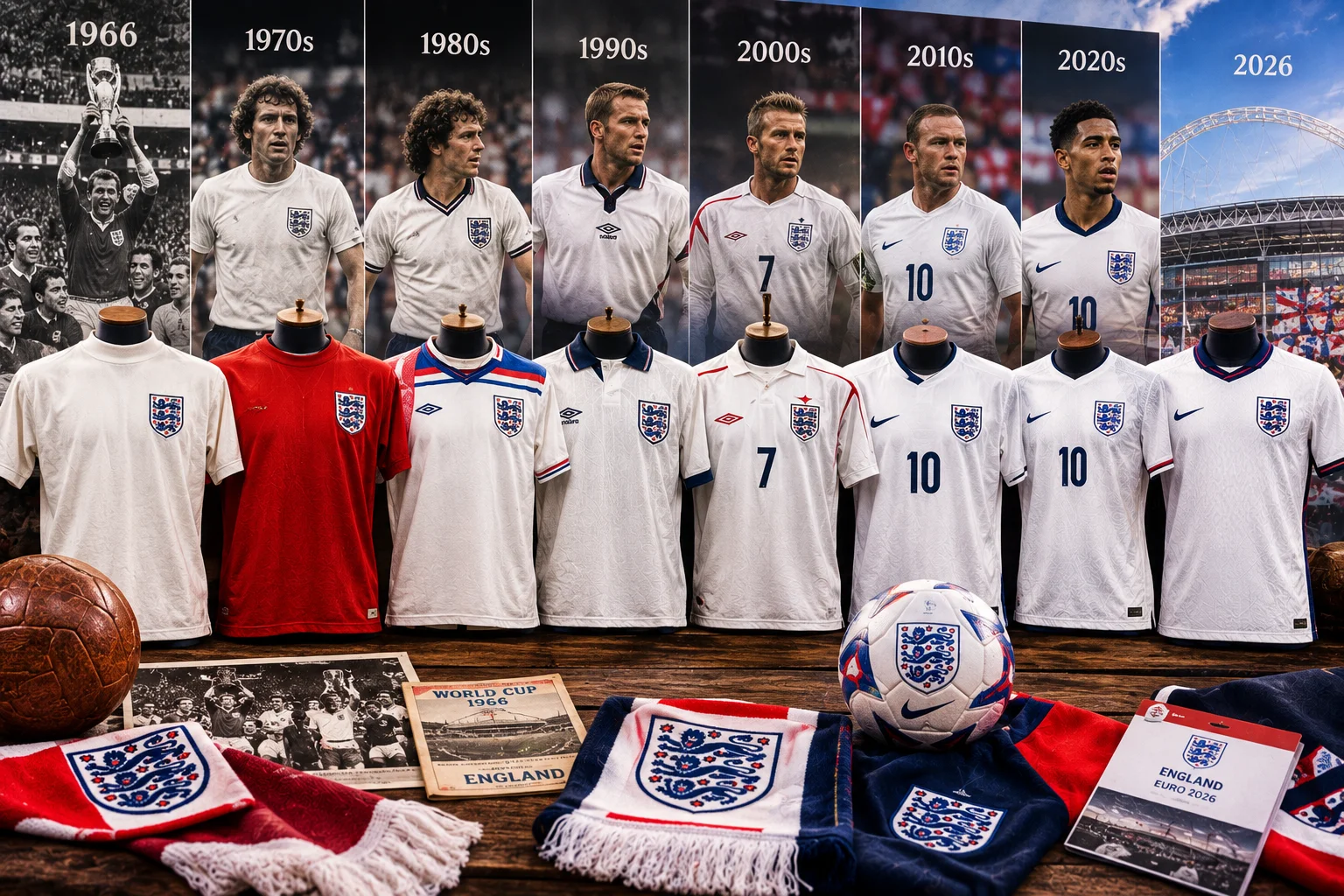
The england football shirt is white for the same reason a lot of things in English football are the way they are: somebody decided in the 1870s and nobody has changed it. The first international, against Scotland in Glasgow in 1872, was played in white shirts with the three lions crest, and every home shirt since has been white. What has changed is everything around the colour: the cut, the crest, the manufacturer, the trim, and the tournaments the shirt was worn in. This is that history, from a red shirt at Wembley in 1966 to a white one with lions woven into it at the 2026 World Cup.
1966: red at Wembley
The most famous England shirt is not white. In the 1966 World Cup final against West Germany, England wore their red change kit because of a colour clash, and Geoff Hurst’s hat-trick, Bob Moore lifting the trophy and Nob Stiles dancing were all in red. Umbro made the shirt, a plain cotton top with a crew neck and the crest on the left breast, and it has been reissued more times than any other England design. The white home shirt of the same tournament, worn in the earlier rounds, is almost as collectable.
Admiral and the 1970s
Admiral won the England contract in 1974 and produced the first England shirt with visible manufacturer branding, and the first with real design: red and blue stripes down the sleeves and around the collar, on a white body. It was worn through the barren years, with England missing both the 1974 and 1978 World Cups, which is perhaps why it is remembered more fondly than the results deserve. The tapered Admiral shirt of 1980 to 1983, with its bold red and blue shoulder panels, is a cult favourite.
Umbro, Italia 90 and Euro 96
Umbro took the contract back in 1984 and held it for nearly thirty years. The 1990 World Cup shirt, white with a subtle diamond pattern and a small crest, was worn Gascoigne, Lineker and Platt to the semi-finals in Turin, and Gascoigne’s tears in it are one of the sport’s defining images. Six years later, at Euro 96, England wore a white shirt with a subtle pattern at home and, against Germany in the semi-final at Wembley, a grey away kit that was mocked at the time and has since been reappraised. The “Three Lions” song, the Gascoigne goal against Scotland and the penalty defeat to Germany all belong to those two shirts.
2000 to 2013: the tailored years
Umbro’s later shirts grew more restrained. The 2000 kit, with a crew neck and red trim, is the design most often cited as the model for the current one. The 2010 World Cup shirt was deliberately tailored, made with a Savile Row cutter’s input, and was worn for a tournament that ended in Bloemfontein and a goal that was not given. In 2013 the Football Association moved the contract to Nike, ending a relationship with Umbro that went back to the 1950s.
Nike and the near misses
Nike’s England shirts have been worn for the closest the men’s team has come to a trophy since 1966: the 2018 World Cup semi-final in Moscow, the Euro 2020 final at Wembley and the Euro 2024 final in Berlin, all lost. The 2024 home shirt caused a row when the St George’s cross on the collar was rendered in navy, purple and light blue, a design decision that reached the House of Commons. It was a reminder of how carefully the shirt is watched.
2026: lions in the fabric
For the 2026 World Cup, Nike produced a white home shirt with a jacquard pattern of lions and stars woven into the fabric, navy and red accents on the collar and side panels, and the words “Happy and Glorious” inside the neck. The crew neck and red detailing echo the 2000 design. The away kit returned to red, paired with navy shorts for the first time, and the launch was framed as signalling a confident new era for the Three Lions. Both shirts used Nike’s Aero-FIT fabric, designed for the heat of a North American summer.
The tournament the shirt was worn for
Thomas Tuchel’s England beat Croatia 4-2 in their opening match in Dallas, with two goals from Harry Kane, won Group L, and went through to the semi-finals, where they lost 2-1 to Argentina. The third-place match against France was one of the strangest games in World Cup history: England won 6-4, Bukayo Saka scoring a hat-trick and Jude Bellingham the last goal deep into stoppage time, to secure the country’s best finish since 1966. Spain beat Argentina 1-0 in the final. The white shirt with the lions in it will be remembered for a bronze medal and for the scoreline against France, which is more than most England shirts get.
The crest and the single star
The three lions come from the royal arms of England and have been on the shirt since 1872, with the ten Tudor roses added later to represent the regional associations. The single star above the crest arrived in 2003, thirty-seven years after the World Cup it commemorates, when the FA noticed that other nations marked their titles and England did not. It is still the only star, and the fact that the women’s team won the European Championship in 2022 and again in 2025 without a star being added to the men’s shirt is a reminder that the two teams, for now, wear different crests.
The Lionesses’ shirt
Since 2023 Nike has produced a separate England women’s design rather than a re-cut of the men’s shirt, and the Lionesses’ kit has sold in numbers that rival the men’s. The 2025 European Championship shirt, worn to a second consecutive title in Switzerland, is among the best-selling England women’s shirts ever made, and the club-level trend it started, women’s kits designed as their own products, is now standard across the Premier League.
What the shirt means now
England’s shirt has always carried more expectation than any club kit, because it is worn everyone and owned no one. The white has never changed and never will. Everything else, the crest, the trim, the manufacturer, is negotiable, and the 2026 design suggests Nike has understood that the shirt works best when it looks like an England shirt. Whether the men’s team ever adds a second star to it is another question. For more on tournaments, travel and the shirts worn along the way, explore LFC Day Trippers.
[…] matchday guide covers it. For a longer view of how one shirt has changed across sixty years, England football shirt history from 1966 to 2026 traces […]